
Blogpost about the ENIUGH Congress written by Hans Hägerdal
Despite having long antecedents, global history as an academic field of study has only taken off in the last few decades. The “whats” and “hows” of the field are continuously being debated, and one forum is the triannual congress of the ENIUGH, or European Network in Universal and Global History. On 10-12 September 2025, the eighth congress since the start was held at the Växjö Campus of Linnaeus University, Sweden. All members of the project Historical Treaties in Southeast Asia were engaged in the sessions, and some of them were instrumental in making the arrangements in cooperation with the ENIUGH hub in Leipzig. About 300 people attended, of which about 250 on site. While a large part of the participants came from European countries, the Americas, Asia, and Africa were also well represented.
The theme for this congress was “critical global histories” which points to the need to reflect on the directions taken by a fast-growing but sprawling field of history, and to address the problems that global history is facing. To these problems belong a lingering strain of Eurocentrism despite ambitions to the opposite, coupled with a neglect of indigenous methodologies. There is also a certain Anglophone bias which overlooks advances in other academic languages. Moreover, global gender perspectives are still in their infancy. The emphasis of many global historians on macro-history and connectivities also call for critical attention, as do the neoliberal leanings of numerous practitioners. Not least, postcolonial and decolonial perspectives have qualified the field and called for a more globally equitable approach.
Many of these discussions were reflected in the sessions and lectures. The congress proper was preceded by a summer school for PhD students, mainly organized by Eleonora Poggio of the Linnaeus University. This two-day event gathered 22 PhD students and 11 senior scholars for discussions in the crossroads of Global History, Gender Studies, Global Diplomatic History, Indigenous Methodologies, History of Empires, and Nordic Colonialism. Seminars centred around topics such as indigenous voices in the sources, diplomacy, and the intersection between Nordic and global colonialism.
The congress itself encompassed some 90 sessions. With such full schedule, numerous parallel sessions was a necessity, with up to seventeen panels going on simultaneously. The backside was that attendance at individual sessions varied wildly.
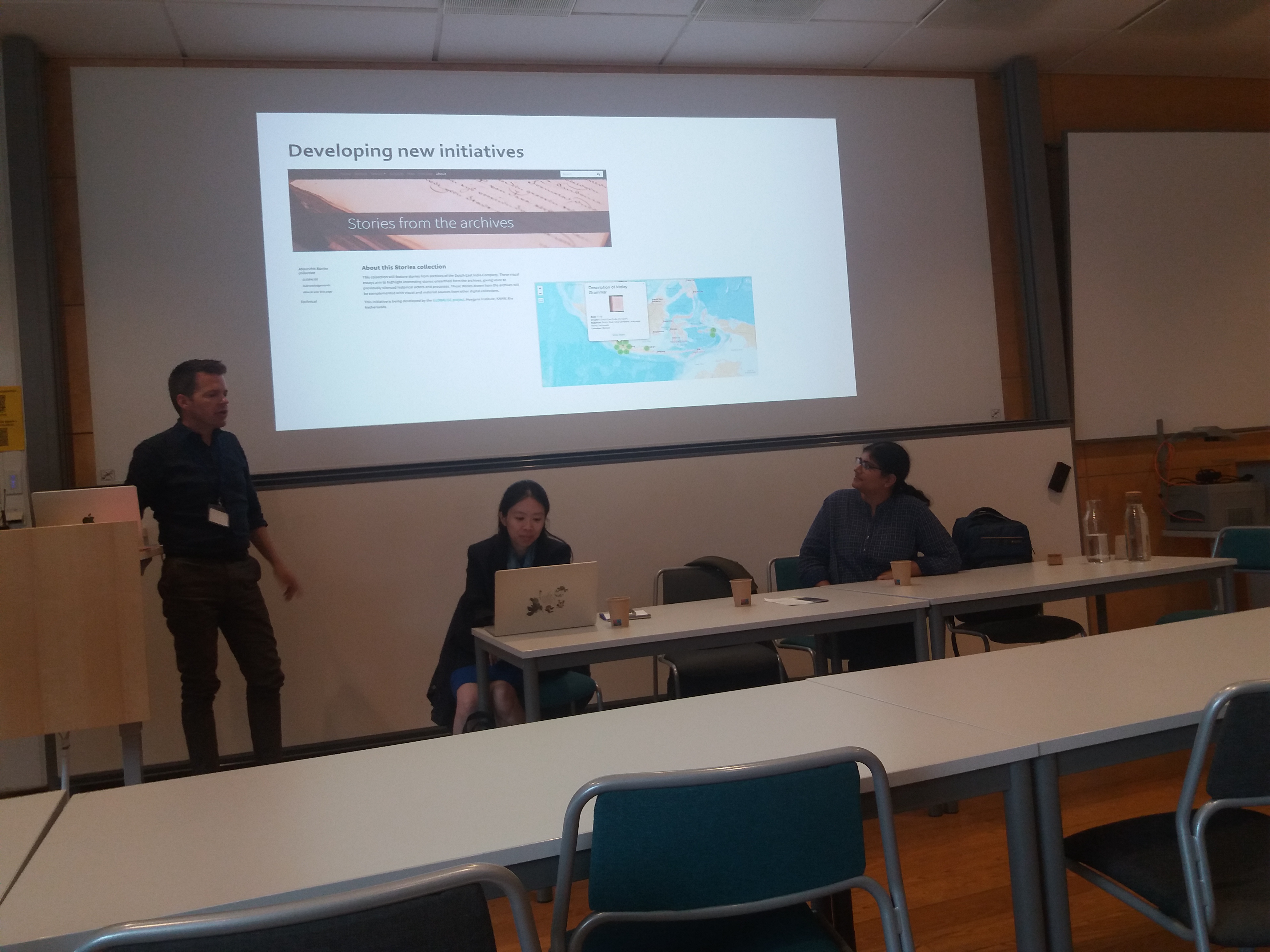
From the roundtable session "Redefining the Limits of Global History: GLOBALISE, the Dutch East India Company Archives and the Early Modern World", explicating new digital methods of processing archival data. From left: Lodewijk Petram, Melinda Susanto, Manjusha Kuruppath
Some of the sessions that attracted a sizeable audience focused on diplomacy and political relations in non-Western contexts. One of the better-known representatives of this research is Saliha Belmessous (University of Oxford) who, with her work, has stimulated a renewed interest in the role of international treaties and treaty-making in the context of modern imperialism. In her paper “Treaties beyond European boundaries”, she explored how Indigenous peoples comprehended treaties and used them to interact with other polities, Indigenous as well as European. Here, Belmessous put the limelight on the diverse forms that treaties could take in Indigenous political contexts, which also means moving beyond the usual emphasis on their materiality as written documents. Oral agreements, artefacts, physical structures, and so on, can also represent treaty-like notions. This point evoked a lively debate in the ensuing discussion.
Of the keynotes, it was especially that of Fe Navarrete (Universidad Nacional Autónoma de Mexico) that addressed the main theme of the congress. In their lecture “Cosmohistories, the
multiplicity of worlds and their histories”, Navarrete suggested cosmohistory as an alternative tool to understand the interaction between different worlds in the global history arena. This means rejecting the idea of world history as a singular process, since such understandings tend to reflect Western ethnocentrism and falls into teleological and tautological traps. Rather, different human communities and their life worlds can coexist, collide, interact, even dominate each other without being fully absorbed into a single process or into a singular causal chain. All this was exemplified by the interaction between Indigenous, Afrodiasporic and Western histories in the early post-contact Americas.
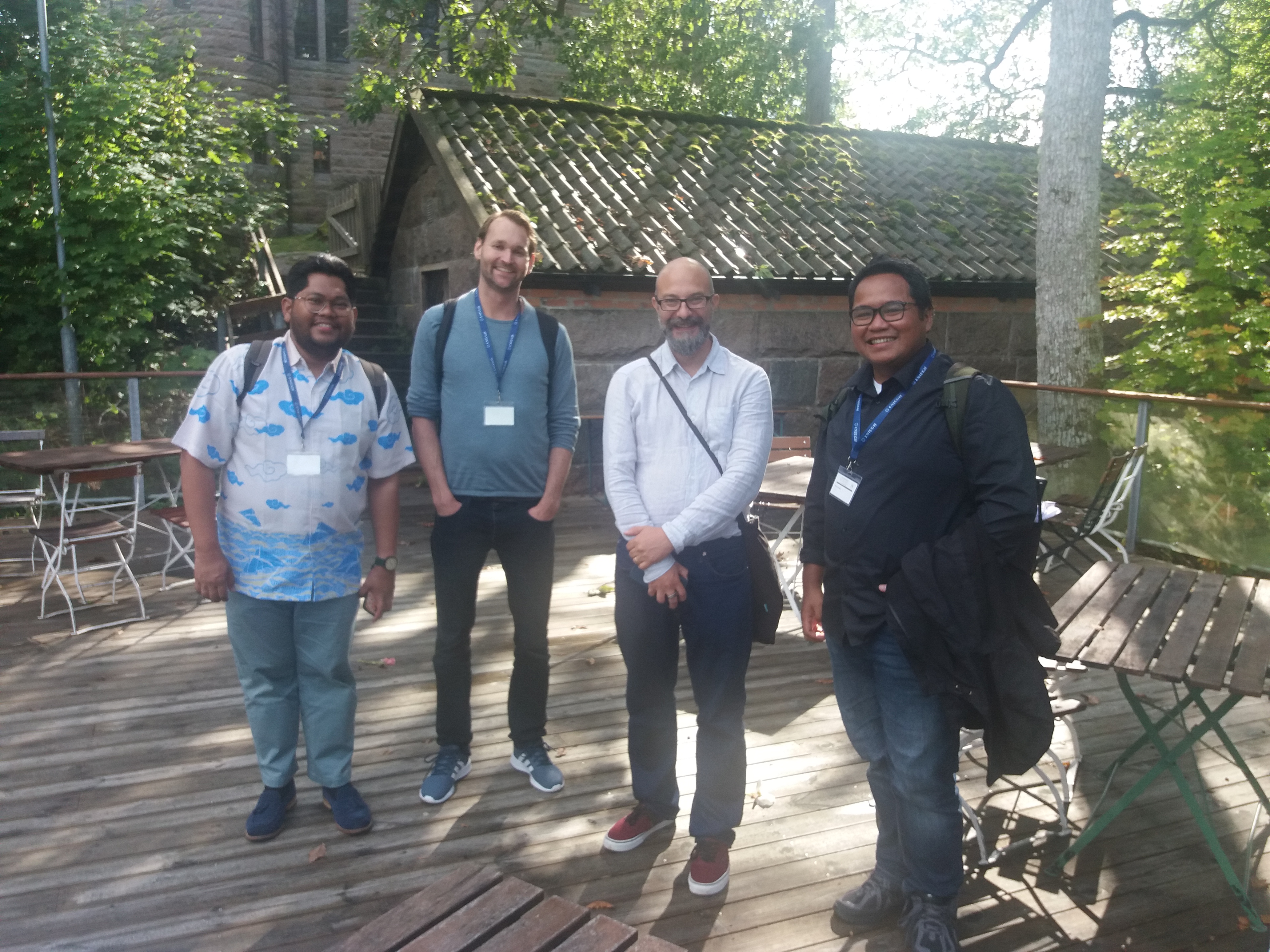
Happy congress-goers outside Teleborg Castle, adjacent to the congress venue. From left: Louie Buana (Indonesia), Maarten Manse (the Netherlands), Michael Talbot (U.K.), Ody (Indonesia).
These are a few examples that may illustrate the perspectives that unfolded at the event. To sum up, the congress provided much food for thoughts by critically trying the ramifications and methods of global history. Three days of intensive discussions strengthened the impression that this historical direction is about to finally step out of the West-centred box. It will be exciting to see how this is followed up at the next congress, planned to take place in Leipzig in 2028.
Hans Hägerdal