Ever since Cambodia became independent in 1953, its border with Thailand has been contested, the ancient Hindu temple Preah Vihear (or Phra Wihan in Thai) being a particular source of discord. To understand the present conflict, it is necessary to look at two treaties concluded in 1904 and 1907.
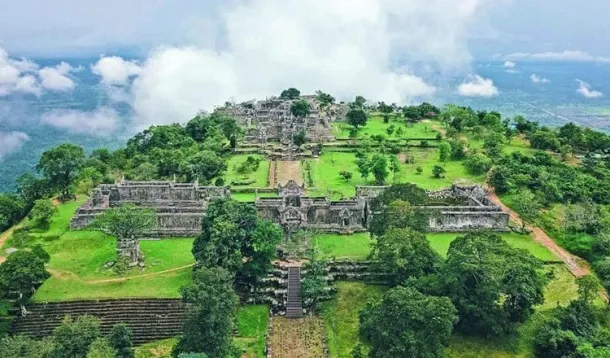
Preah Vihear temple ruin. Source: UNESCO.
Like all national borders of present-day Southeast Asia, the border between Thailand and Cambodia was determined by treaties concluded in the colonial era. During the nineteenth century, Siam, as Thailand was known at the time, came under increasing pressure from European commercial and colonial expansion and was compelled to sign treaties with several imperial powers. In these, Siam, among other things, granted commercial privileges and extraterritorial legal rights to the citizens of the imperial treaty parties. Such treaties are often referred to as ’colonial’ or ’unequal’ treaties, implying that they were unjust instruments of imperialism imposed on weak non-European parties by powerful European or American countries.
Such analyses can be justified but they nevertheless tend to obscure crucial aspects of the treaty relations of nineteenth- and early twentieth-century Southeast Asia. For example, even though Siam was forced to make substantial concessions to the Great Britain, France and other imperial powers, the country was also itself an imperial power in the region. Particularly during the first decades of the Chakri Dynasty – which still occupies the throne of Thailand − in the late eighteenth and early nineteenth centuries, Siam expanded or consolidated its territory in virtually all directions, including in the east, where both Cambodia and Laos came under Siamese suzerainty.
French expansion in Indochina (that is, present-day Vietnam, Laos and Cambodia) from the1860s reversed the process and eventually forced Siam to give up its claims to both Laos and Cambodia to the French. In the following decades, a series of treaties was negotiated but the borders between Siam and French Indochina remained ill-defined, which was a cause of friction between the two powers. Another source of discord were the extraterritorial rights – that is, the right of Europeans to be tried under their homeland’s laws and courts − that Siam had been forced to grant to France and Britain. For the Siamese, such concessions were humiliating, particularly in the light of Siam’s vigorous modernisation under King Chulalongkorn or Rama V (r. 1868−1910), an important part of which was judicial reform. Toward the end of the century, the affront was augmented by the insistence of the European powers that extraterritoriality be extended to Asians living in their colonies. For Siam, these populations were far more numerous and potentially troublesome than the few Europeans who happened to be in the country.
In 1897, Chulalongkorn travelled to Paris in order to settle these and other matters with the French. Diplomatic negotiations continued after the king had left France and eventually, in 1904, resulted in a treaty which, among other things, described (in text) the border between Siam and Cambodia. The treaty also provided for a mixed border commission, comprised of officers appointed by the two treaty parties (that is, France and Siam), which was to delineate the border between the two countries, that is, create maps showing the exact location of the border.
Initially, the work of the commission was hampered by linguistic differences. After a complaint by the chair of the commission, Colonel Fernand Bernard, Siam replaced its members with three officers who had studied in France and Belgium and were fluent in French. According to Bernard, these changes showed that the Siamese government was determined to have its interests defended in the commission. The work seems to have run much more smoothly afterwards.
However, the commission discovered that the border described by the treaty, because of a combination of miswording and ignorance of the terrain, was impracticable and would have left Siam with a potentially very unsecure border. Based on his contacts with the Siamese commission members and officials, Bernard thus suggested that a new treaty be negotiated to correct the problems as well as to find a solution to the issue of the extraterritorial rights of France’s Asian subjects.
The result of these negotiations was a new treaty, concluded in 1907. For Siam, the treaty was important in that it abolished most of the extraterritorial rights for Asians from French Indochina. Moreover, in contrast to the 1904 treaty, which was described as aiming to ’regulate certain difficulties’ in a previous treaty from 1893, the new treaty aimed to ’ensure the final regulation of all questions relative to the common borders of French Indochina and Siam’. The joint border commission was again charged with the task of delineating border, which now had been modified since Siam also had agreed to cede the last of its Cambodian provinces to France.
With regard to the area near Preah Vihear, however, the wording of the two treaties was identical: The border was to be defined by the watershed – that is, the line which separates waters flowing to different rivers, basins or seas – of the Dângrêk Mountains. As a result, the commission, it its final report − the central part of which consisted of eleven detailed maps of different sections of the border − clearly placed Preah Vihear on the Cambodian side of the border (see image).
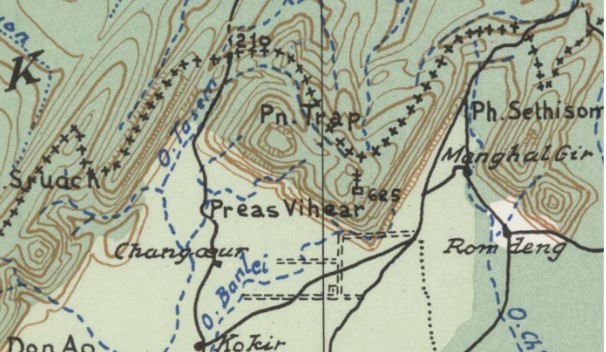
Detail of the Mixed Border Commission’s map of the Dângrêk Mountains region (1908). The border is marked with +++ and the temple, named Preas Vihear, located south of the border, i.e. on the Cambodian side. Source: Wikimedia Commons.
At the time, Preah Vihear was little known and seen as being of limited interest, the temple being far smaller and less accessible than the impressive Angkor Wat complex. Neither the Siamese or the French members of the commission could have foreseen that Preah Vihear would be the object of so much conflict and discord many years later. However, the temple is not the main issue at stake in the present conflict, which has other, more contemporary dimensions, including domestic politics in both countries and cross-border criminal activities.
To blame the 1904−08 border commission for the present troubles is thus unfair. Neither is it correct to say that the border was delineated by French officers since the commission was a mixed body composed of officers from both Siam and France with both sides taking an active interest in the work of delineating the border. The treaty of 1907, moreover, was not unambiguously an unequal treaty imposed on Siam by France. It can rather be seen as the outcome of a ten-year long diplomatic process – originally initiated by Siam’s King Chulalongkorn − through which Siam, in exchange for its cession of territory, achieved an important goal, the abolition of extraterritorial rights for Asians under French protection. This set the course for the subsequent elimination of all extraterritorial rights for foreigners, including Europeans, in Siam, something that was of much greater consequence for Siam at the time than the fate of a largely forgotten temple ruin.
By Stefan Amirell
Further reading:
Briggs, L. P., ‘The Treaty of March 23, 1907 Between France and Siam and the Return of Battambang and Angkor to Cambodia’, Far Eastern Quarterly 5:4 (1946): 439−454.
De Rugy, M., Imperial Borderlands: Maps and Territory-building in the Northern Indochinese Peninsula (1885−1914), Leiden: Brill 2021.