
Blog entry written in September 2025 by Maarten Manse
Treaties in Southeast Asia have long attracted scholarly attention. They are often seen as
foundational in the development of international law and international relations. However,
while much has been written about European legal frameworks and colonial diplomacy, far
fewer historians have ventured to explore how local actors understood and interpreted these
agreements (Amirell 2023). Taking an indigenous perspective in Java reveals a different story:
treaties were not simply imposed instruments of foreign control, but dynamic legal and
symbolic tools integrated into local Javanese political and cosmological systems.
The Sultanate of Banten illustrates vividly how court officials actively reworked treaties to
serve dynastic, political and ideological ends. In 1684, following a turbulent court uprising
and intervention by the Dutch East India Company (VOC), Sultan Haji (r. 1682−1687) signed
a treaty securing his recognition as ruler. Yet elements within the courtly elite resisted,
viewing Haji’s collaboration with the infidel Dutch and the overthrow of his father, Sultan
Ageng Tirtayasa (who had led Banten to the heydays of its glory), as illegitimate.
In the Sejarah Banten, an important chronicle recanting the history of Banten, Sultan Haji
appears under his princely name, Pangeran Dakar. He is described as having been deceived by
an evil spirit while en route to Mecca for pilgrimage (hence his nickname ‘Haji’), who
assumed his identity by taking Haji’s cloak. The crisis and collapse of the court is explained
as the consequence of the spirit’s posing as Haji (Wessing 1993, 2014).
The treaty is described as an agreement made at the initiative of Haji (Pudjiastuti 2000, 139)
and the takeover of sovereignty, as imposed by the treaty, as a reward for Dutch military aid.
The implication is that, while it were the Dutch who proposed the deal, Haji, though
misguided, remained a sovereign actor who accepted these terms. The chronicle thus presents
a different power balance than we find in VOC sources. Selective translation of the treaty text
(from Dutch to Malay, written in the Jawi, i.e. Arabic, script) helped to extend these ideas into
the local representation of the treaty itself.
Seen as such, Banten’s subjugation was not a mere colonial imposition but the outcome of
divine will amid disorder, simultaneously preserving the Sultan’s agency and embedding
Dutch ascendancy within a local morally and cosmologically intelligible order. Talens (2004,
116) notes that the treaty was framed as a commercial contract rather than a claim to
overlordship, reflecting subtle distinctions between the Dutch and Javanese texts.
Practices of translation and interpretation were crucial to simultaneously record,
contextualize, rework and embed new treaties into dynastic myths and cosmological
narratives. In Banten, the qadi (or Faqih Najmuddin, supreme judge), seems to have played a
pivotal role in mediating, adjudicating, and administering the treaties in the late seventeenth
century. The famous Qadi Pangeran Tajuddin acted as a political advisor, diplomat, and
custodian of royal legitimacy (Van Bruinessen 1994, 166−170; Talens 1993, 338, 345). He
seems to have selectively incorporated specific treaty provisions into the Undhang-Undhang
Bantĕn, (Laws of Banten), an important legal compilation, emphasizing articles regulating the
Sultan’s rights and the obligations of the VOC, while omitting clauses asserting Dutch
supremacy (Yakin 2016, 377, 453−467). In effect, the treaties were thus domesticated and
reframed as instruments of justice and moral authority, aligned with Islamic legal principles.
This enabled the Sultan and his court to enter into foreign relations without ceding
sovereignty while preserving the notion of divine kingship of the Sultan under foreign, non-
Muslim dominance.
Further cases from Java − explored in the research program Historical Treaties of Southeast
Asia − reinforce this point. In Mataram in Central Java, for example, treaty terms were
rendered in Javanese – often translated from Dutch via Malay – so that their substance was
absorbed into local regimes of literacy and meaning (Amirell & Manse 2024; Peacock 2024,
38−39). Translation here was not a matter of faithfully rendering European intent but of
recasting foreign instruments to fit with established idioms of kingship, hierarchy, and Islamic
models of legitimacy.
Taken together, these cases demonstrate that treaties in Southeast Asia were never mere
vehicles of European domination. Through translation, selective incorporation and narrative
reinterpretation, indigenous actors inscribed them into their local histories, affirming
sovereignty, consolidating dynastic authority and reframing colonial power as part of a
divinely structured order. To study treaties from this perspective is to recognize the legal and
discursive creativity of Southeast Asian elites in the making of both colonial empire and
international law.
Maarten Manse
September 2025
References:
Amirell, S.E. (2023). ‘Tools of imperialism or sources of international law? Treaties and diplomatic relations in
early modern and colonial Southeast Asia.’ History Compass, 21(12), 1−13.
Amirell, S.E., & Manse, M. (2024). ‘Treaty-Making and Translation: European and Asian Versions and Their
Paper Trails.’ Diplomatica, 6(2), 311−339.
Bruinessen, M. van (1995). ‘Shari’a Court, Tarekat and Pesantren: Religious Institutions in the Banten
Sultanate.’ Archipel 50(1), 165−199.
Peacock, A. C. S. (2024). Arabic Literary Culture in Southeast Asia in the Seventeenth and Eighteenth Centuries
(Leiden: Brill).
Pudjiastuti, T. (2000). Sadjarah Banten: Suntingan teks dan terjemahan disertai tinjauan aksara dan amanat.
PhD Dissertation, Universitas Indonesia, Depok.
Talens, J. (1993). ‘Ritual power; The installation of a king in Banten, West Java, in 1691.’ Bijdragen tot de Taal-,
Land- en Volkenkunde, 149:2, 333−355.
Talens, J. (2004).‘Het sultanaat Banten en de VOC, circa 1680−1720: Nieuwe tijden, nieuwe verhoudingen.’ In
E. Locher-Scholten, Hof en handel: Aziatische vorsten en de VOC 1620−1720 (Leiden: KITLV), 113−138.
Wessing, R. (1993). ‘A change in the forest: Myth and history in West Java.’ Journal of Southeast Asian Studies
24(1), 1−17.
Wessing, R. (2014). ‘Pangeran Dakar’s error: A narration of the events leading to the fall of the Sultanate of
Bantén.’ Journal of Southeast Asian Studies, 45(3), 427−443.
Yakin, A. U. (2016). ‘Undhang-Undhang Bantěn: A 17th to 18th-century legal compilation from the qadi court
of the Sultanate of Bantĕn.’ Indonesia and the Malay World, 44(130), 365−388.
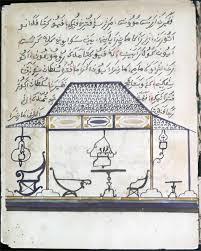
Selected page from a copy of the Sejarah Banten.
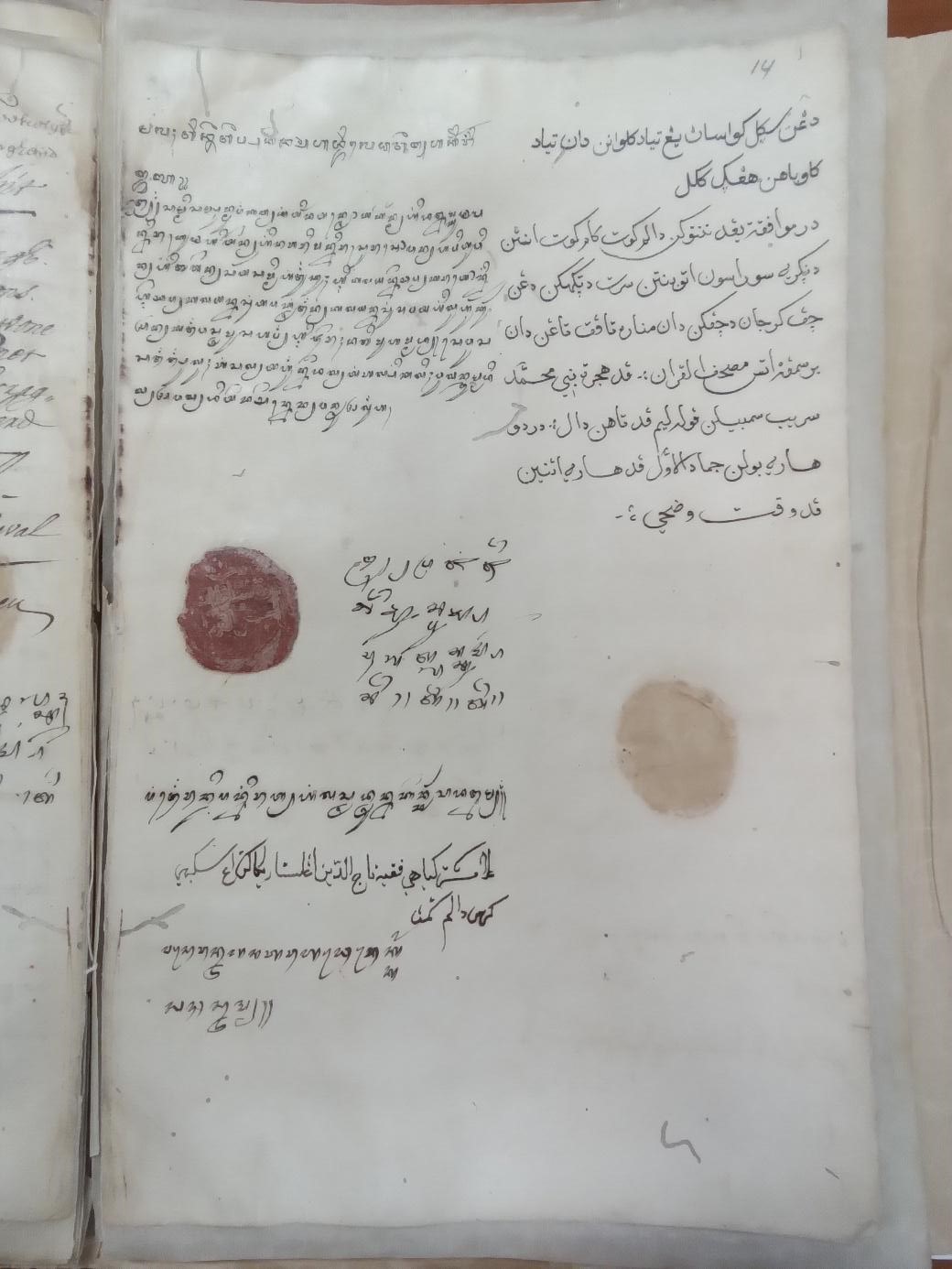
Sultan Haji’s signature and seal underneath the 1684 treaty with the Dutch East India Company